
Inside Palantir: Gotham
This is the second deep-dive of a series of overlapping research on B2G AI, documenting and analysing the market landscape and its trajectory.

Summary:
Palantir Gotham is the archetypal “data operating system” built for intelligence, defence and high-stakes investigations. Its strengths are deep integration of heterogeneous data, analyst-centric workflows (graph + map + timeline), provenance and access-control discipline, and proven battlefield/operational performance. That combination creates high switching costs and mission-level stickiness. But Gotham is also expensive, heavyweight and historically bespoke; it is less well suited to the fast, cheaper, cloud-native world of many commercial buyers or to smaller government entities. For investors: Gotham represents a reliable revenue stream and strategic anchoring for Palantir in the public sector, but most of the company’s re-rating opportunity today sits with commercial growth (Foundry / AIP). For VCs and founders: the gaps around automation, pricing tiers, lightweight deployments, ML/LLM native toolkits and developer ecosystems are places to attack, especially if you can make integration with Gotham trivial and defensible.
Key Signals:
Strengths: unparalleled data fusion for classified environments; rigorous provenance, access controls and auditability; proven operational deployments in conflict zones and intelligence agencies.
Revenue role: Gotham is the classic “bread and butter” government product, sticky, multi-year, and high value per account. It underpins Palantir’s government cash flows even as commercial Foundry/AIP now drive growth.
Catalysts: JADC2 / TITAN / persistent great-power competition, allied adoption (NATO, Five Eyes), and programs that require multi-vendor orchestration where Palantir’s access model and security posture are differentiators.
Risks: procurement timing and concentration; reputational/regulatory risks; potential commoditisation by hyperscalers and integrated government stacks; and the long, services-heavy deployment model that limits gross margin expansion.
Opportunities for third parties: “Gotham-lite” products for mid-sized agencies, specialised ML/LLM modules (multimodal fusion, radar analytics), connector ecosystems, and compliance/hosting services that reduce the barrier to entry for allies and smaller governments.
Product overview:
Gotham is Palantir’s analyst platform designed for investigative, intelligence and operational workflows. Think of it as an interface and execution layer on top of a set of data engineering and governance primitives tailored for classified and sensitive environments:
Data integration: connectors to structured sources (databases, ERP, CRM), semi-structured (logs, XML), and unstructured (PDFs, emails, imagery). Heavy investment in deduplication and entity resolution.
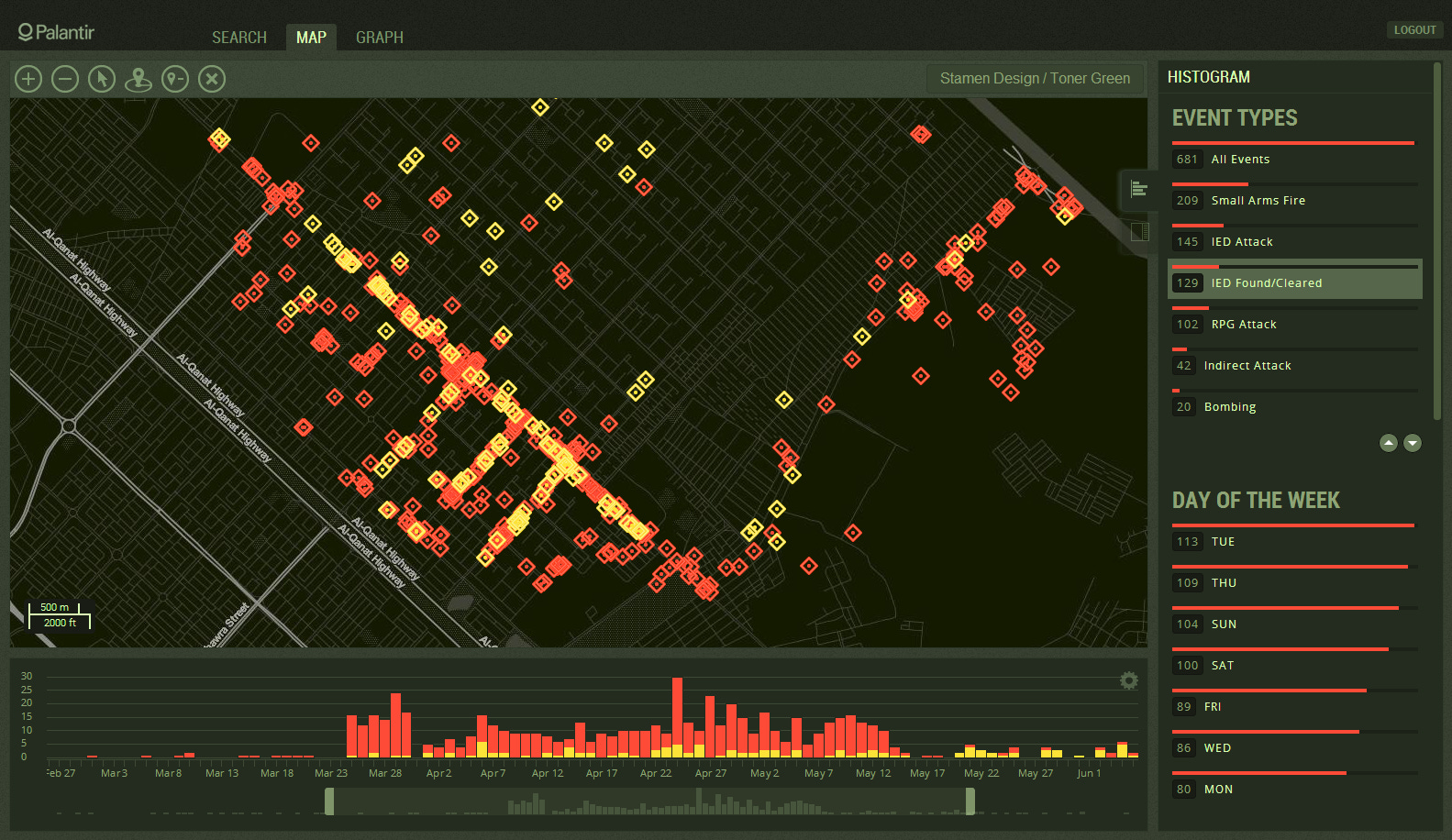
Model of the world: entity graphs (people, organisations, assets), geospatial layers and event timelines; users navigate by link, map, filter and query rather than raw SQL.
Analytics & workflow: ad-hoc exploration for analysts, repeatable pipelines for analysts-to-operators handoff, and scenario simulation. Historically, more manual and analyst-driven than fully automated, but with robust primitives for codifying logic.
Security, provenance & RBAC: fine-grained access controls, immutable provenance trails, and auditing functionality that satisfy FedRAMP/IC/DoD requirements. This is the “mission” part of Gotham’s value.
Deployment profile: air-gapped, hybrid, and cloud-hosted options with long implementation projects, significant professional services, and often on-site presence during early adoption.
How Gotham Works:
Gotham’s secret sauce is less flashy models than a system that makes messy, heterogeneous national-security data usable:
Ingest & canonicalise: raw sources are ingested; automated pipelines and manual rules resolve entities (the deduplication use case is a recurring theme).
Enrich & correlate: external enrichment (watchlists, imagery, signals) is merged; analysts iterate on the graph to find links and hypotheses.
Provenance & trust: every link, merge and annotation is recorded with source metadata; this supports legal, operational and audit requirements in sensitive missions.
Operationalise: dashboards, comms and tasking layers move insights to decision makers and operators; integrations to downstream tools enable actionability.
Two operational consequences follow: (a) Gotham’s value scales with domain knowledge and curated ontologies (you get more value by building and re-using ontologies across programs), and (b) the product is people-intensive during onboarding; both Palantir staff and customer analysts are normally deeply involved.
Customers & Use Cases:
National intelligence & defence: link analysis, target development, sensor fusion, logistics and operational planning. Gotham’s provenance and access control fit here.
Law enforcement & counter-fraud: criminal network analysis, financial investigations, complex case management.
Critical-infrastructure & corporate security: protective intelligence for executives, high-sensitivity incident response.
Procurement & program planning: used to simulate lifecycle costs and support large fleet procurement decisions for defence agencies (in some programs, Gotham is used in evaluation workflows).
Value metric: the platform sells on operational outcomes (faster investigations, more confident decisions, fewer false positives, and mission-critical uptime), not on typical SaaS metrics. That’s why deals are large and sticky.
Market Landscape & Competition:
Direct/adjacent competitors and substitutes:
IBM i2 / iBase / i2 Analyst’s Notebook: classical graph analytics and link-analysis suites historically enterprise-grade but less integrated in modern data-ops contexts.
Specialists (Ontic, Tamr, Systecon): niche vendors for protective intelligence, data mastering, or lifecycle logistics simulation. They win where Gotham is overpowered or too costly.
Internal builds: many large agencies have legacy in-house systems; internal IT remains the most common “competitor” during procurement.
Hyperscalers/cloud SI-led stacks: cloud vendors (AWS, Azure) and large systems integrators increasingly package data processing and analytics for governments; these are a potential long-run threat if they can satisfy classification and supply-chain requirements.
New entrants (Anduril, Shield, start-ups): these typically offer point solutions (sensors, autonomy, ML modules) and may partner with or integrate into Gotham rather than replace it.
Competitive positioning: Gotham is less a product replacement play and more a platform glue that enables disparate algorithms, sensor networks, and specialist models to be operationalised with robust governance. That makes it defensible but also a target for modular competition.
Strengths & Moats:
Mission-grade credibility: deployments in crises and conflicts are a powerful social proof that is hard to fabricate.
Data governance & security: provenance and RBAC are non-negotiables in classified environments. Gotham is built for that from Day 1.
Network effects via ontologies: client-specific ontologies and institutional knowledge become reusable assets and create switching costs.
Ecosystem leverage: Gotham frequently sits as the integrator of third-party models and sensor feeds, making Palantir the natural integrator.
Human+software product model: the combination of experienced deployment teams and platform creates lock-in that pure software vendors struggle to replicate quickly.
Weaknesses & Gaps:
Cost & complexity: Gotham is expensive to license and to implement. Many agencies and mid-sized customers cannot justify the price or the service load. There is a clear market for cheaper, faster deployments.
Automation vs manual: Gotham historically relied on manual analyst work and bespoke configurations. There’s an opportunity for automation (ML/LLM native features, entity recognition, automatic inference) to compress time-to-value.
Developer experience & extensibility: Gotham is powerful for analysts but less friendly as a developer platform for third-party innovators. A modular developer marketplace or simpler SDKs could open opportunities.
Cloud & scale economics: while Palantir has addressed cloud and FedRAMP needs, hyperscalers’ economies of scale may exert downward pressure on pricing for non-classified workloads.
Perception & politics: Palantir’s reputation (real or perceived) occasionally slows adoption in some liberal democracies and civil-service organisations. A product that is transparently privacy-preserving may win market share where Gotham is seen as politically sensitive.
Implication for founders/VCs: Build middleware and tools that remove the heavy lifting, faster connectors, automated entity resolution, domain-specific LLMs for defence (radar, SIGINT), and “Gotham-compatible” low-touch deployment templates. Sell to agencies and primes as accelerators that reduce Palantir billable services and procurement friction.
Procurement Realities & GTM:
Sales cycle: long and political. Gotham often enters via referral, pilot or prime-sub relationships. The buyer is rarely a single procurement officer; it’s typically a program office or an operational unit.
Delivery model: professional services + embedment. Early years: large Palantir teams on site. Over time, Palantir has productized aspects of deployment (Apollo, FedStart, Mission Manager), but onboarding still requires domain experts.
Contracting vehicles: deals can be direct GSA/JAIC/OTAs, subcontracted under primes, or part of larger programs of record. Litigation and procurement rules have historically shaped access (e.g., DCGS litigation).
Conversion dynamic: For many customers, Gotham’s ROI is qualitative and mission-aligned; measurable ROI often emerges only after months of integration, making bootstrapped pilots and executive sponsorship critical.
Financial & business model implications:
Revenue durability: Gotham drives multi-year, high-ACV contracts with strong renewal dynamics due to switching costs.
Margins: Software gross margins are high for the product; however, services and on-site engineering dampen overall margins unless product-led automation reduces service intensity. Palantir’s path to scale in commercial markets suggests the company is trying to reduce this friction for Foundry/AIP; Gotham’s services intensity will be an ongoing factor.
Concentration: government revenue can be lumpy (contract timing, appropriations) and concentrated across large accounts, a risk in downside scenarios.
Risks & Challenges:
Procurement timing: near-term revenue volatility due to continuing resolutions and long acquisition cycles.
Regulatory/reputational: public scrutiny over surveillance, privacy or military engagements can affect renewals or new contracts in some markets.
Commoditisation risk: hyperscalers + SIs standardising secure enclaves could poach non-classified workloads or commoditise some functionality.
Founder/management & culture risks: Palantir’s culture and product delivery model is specialised if leadership shifts strategy uncomfortably, execution risk rises.
Technical debt & modernisation: maintaining air-gapped and highly customised deployments is expensive and could limit margin expansion if not productized.
Strategic Scenarios & Valuation Implications:
Base case: Gotham remains a stable backbone of government revenue; commercial growth (Foundry/AIP) drives multiple expansions of the company. Gotham delivers durable RPO and renewals, but limited margin leverage unless service intensity falls.
Bull case: Palantir successfully productizes much of the Gotham onboarding (Mission Manager / FedStart / Apollo) and captures the multi-vendor orchestration market; government budgets shift to software, and Palantir becomes the standard data-ops backbone for allied forces.
Bear case: procurement delays, political backlash or hyperscaler integration erode Gotham’s privileged position; growth stalls and margins compress if Palantir must discount heavily to preserve pipeline.
Investor Perspective:
Value Gotham as durable income, rather than a growth engine. The upside from Palantir’s share re-rating will likely come from commercial growth (AIP/Foundry) and Apollo-style infra monetisation. Treat Gotham revenue as high-quality, mission-critical cash flow that stabilises cash generation.
Watch metrics that matter: wins on TITAN/Army Vantage; number of government deployments shifted from services to self-service (proxy for margin scaling); dollar retention in gov accounts; and marketplace/partner traction (FedStart, Mission Manager).
Monitor political/regulatory headlines in key markets (U.S., U.K., EU, Israel); negative attention can translate into delays or lost renewals.
Competitor Investment Opportunities:
Invest in modular, integrable products that lower the cost of adopting Gotham: ML model packaging, connectors, vettable LLMs for classified data, and tooling that automates entity resolution. The winner is the company that becomes a safe, certified extension of Gotham.
Prioritise clearance and compliance early. Start-ups that can operate in IL-5/IL-6 or FedRAMP environments unlock far higher deal sizes and strategic partnerships. FedStart-style offerings that accelerate that path are valuable.
Go after underserved buyers, mid-sized defence agencies, allied partners with smaller budgets, and municipal law-enforcement agencies with lighter, faster, cheaper products.
Competitor Product & GTM Playbook:
Product: ship connectors, out-of-the-box ontologies, and ML pipelines that reduce analyst time by >30% on key workflows (entity resolution, geospatial matching, automated triage). Build domain specificity (radar, SIGINT, customs, port surveillance) to win against generalists.
Trust & security: invest in certifications, supply-chain attestations and transparent data-handling practices. Sell trust as a primary feature.
GTM: partner early with primes and integrators; aim to be an embedded subcontractor on OTAs and DIU/AFWERX pilots. Use “accelerators” that reduce Palantir billable services as your value proposition.
Pricing: consider outcome-linked pricing for pilot phases (e.g., pay on validated operational impact) to overcome procurement frictions and executive risk aversion.
Due diligence checklist:
Technical: How modular is Gotham’s data model? How easy is it to plug in third-party ML models? How is provenance enforced?
Operational: What is the average onboarding time and services spent for a typical Gotham deployment? How many customer FTEs are required to operate post-deployment?
Commercial: What are the top 10 government contracts (size, renewal cadence)? Is revenue concentrated in a few program offices?
Regulatory & legal: Any active litigation or major policy challenges? Export controls or sanctioned market exposure?
Partner/ecosystem: Are there partner programs (FedStart, Marketplace)? Who are the biggest systems integrator allies?
Defensive: How would a hyperscaler or an allied standard (e.g., an EU data-trust) undercut Gotham on price or procurement ease?
Closing:
Palantir Gotham is a classic enterprise asset: expensive to buy, expensive to displace, and uniquely capable in contexts where lives or national security depend on flawless data provenance and integrated analytics. For Palantir, Gotham remains the strategic anchor that wins trust and access in the most sensitive environments; the firm’s commercial re-rating, however, will depend on how much of Palantir’s engineering DNA (security, provenance, orchestration) can be productised, automated and broadened (via Foundry/AIP, Apollo, Mission Manager) to lower price points and new buyers.
For investors, Gotham is a defensive moat inside a larger investment story; for founders, its weaknesses point to concrete opportunities simplify, certify, automate and integrate. The most interesting start-ups will not try to “replace” Gotham head-on but to become its safest accelerant.